
Why Smart Money Is Buying NNN Properties in 2026 (and What Bonus Depreciation Has to Do With It)
September 29, 2026By Chris King, North Miami Real Estate Advisor, Compass FL
Let me tell you what I’m hearing from my clients right now. Business owners, doctors, people who just had a big year. Same question every time: “Chris, where do I put money that pays me and cuts my tax bill?”
Lately, more and more, my answer is NNN properties.
A lot of my waterfront clients in North Miami, Bal Harbour, and Surfside are doing exactly this, pairing their primary home on the water with income property that pays them every month. The house is the lifestyle. The NNN is the wealth engine.
Why Florida Investors Care About This
Florida has no state income tax. That’s a big part of why so many high earners have moved here, and it changes how you think about taxes once you arrive. When there’s no state tax to plan around, the federal side is where the real savings are. That’s where strategies like bonus depreciation come in.
If you’re new to Florida or still making the move official, read my post on making Florida your primary residence first. The tax benefits only work if your residency holds up.
Here’s the Play
So what is NNN? Simply put, triple net means the tenant pays the property taxes, the insurance, and the maintenance. Meanwhile, you collect rent.
For example, we’re talking oil change shops, drive-thrus, pharmacies, and auto parts stores, usually national or franchise tenants on long leases. As a result, there are no tenants calling you about a leaky faucet and no property manager eating your margin. Just a check.
Before you jump in, though, know this: not every “NNN” lease is created equal. Some leave the roof and structure on the landlord, while an absolute NNN puts it all on the tenant. So read the lease before you fall in love with the cap rate.
Ultimately, for people who’ve already built their wealth and don’t want a second job managing it, it’s hard to beat.
Why 2026 Is Different
Now here’s what changed. Congress changed the math.
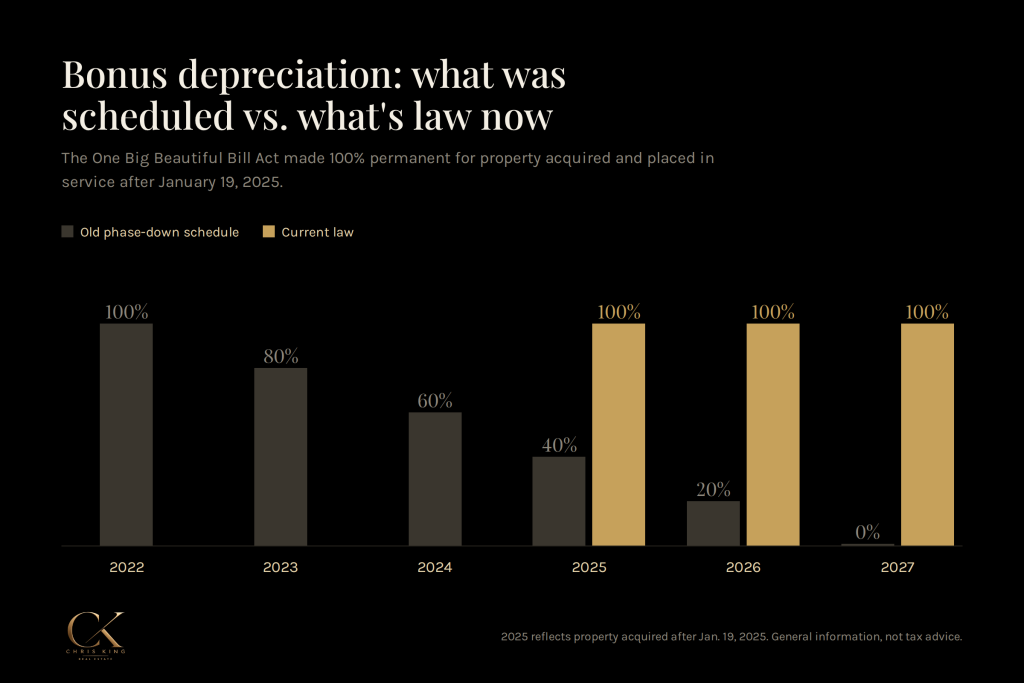
Specifically, the One Big Beautiful Bill Act, signed July 4, 2025, made 100% bonus depreciation permanent for property acquired and placed in service after January 19, 2025. Under the old rules, by contrast, it was dropping to 20% this year and zero next year. In short, that door was closing. Now it’s wide open, and it’s staying open.
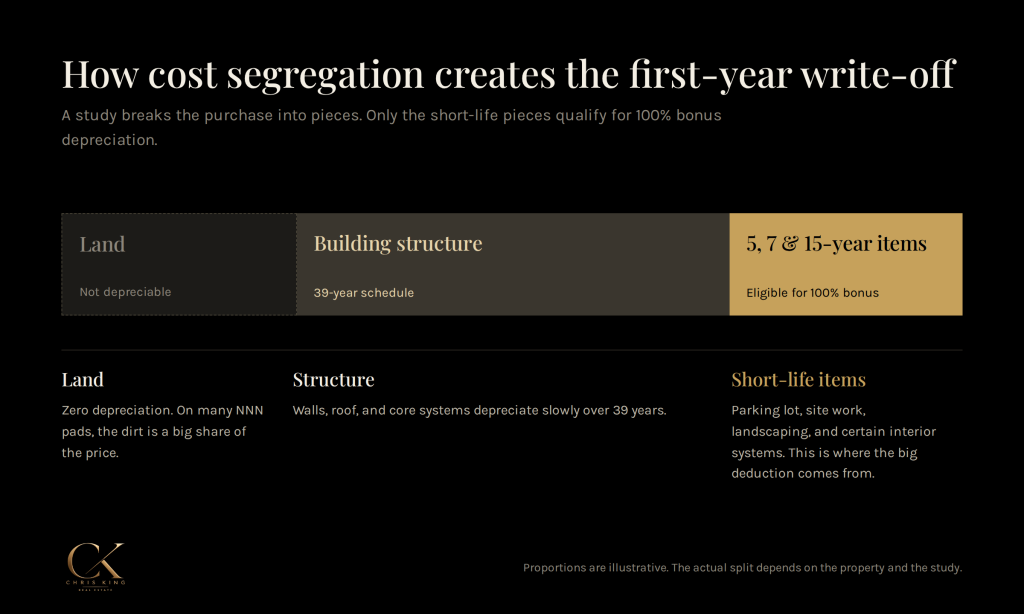
However, let me clear something up, because I hear this wrong all the time. You’re not writing off the whole building in year one. Normally, commercial buildings depreciate over 39 years. Instead, what you do is order a cost segregation study, which breaks the property into pieces: parking lot, site work, landscaping, and certain interior systems. Those pieces then fall into 5-, 7-, and 15-year buckets, and those buckets qualify for 100% bonus depreciation.
That’s where the big first-year deduction comes from. And that’s the play.
That’s where the big first-year deduction comes from. That’s the play.
What I’m Seeing on the Ground
With all that in mind, here’s what’s actually happening in the market:
- High earners are using NNN to offset other income. That said, the ones who win have the right tax profile to actually use the losses. Your CPA tells you if that’s you. Then I’ll find you the deal.
- On the other hand, not every NNN deal is a tax monster. Land doesn’t depreciate, and on a lot of these pads, the dirt is a big chunk of the price. So if someone’s pitching you a write-off without talking about the land allocation, walk away.
- At the same time, 1031 buyers are hungry. People cashing out appreciated property are rolling into NNN to defer gains and stop managing tenants. Naturally, that means real competition for good deals.
- Above all, it’s tenant first, tax second. A great write-off on a weak tenant is still a bad deal, no matter how good the depreciation looks.
The Stuff Most People Won’t Tell You
I’ll be straight with you, because that’s how I do business.
Rental losses are generally passive. If you’re a passive investor, you usually can’t use them against your W-2 income unless you qualify as a real estate professional. The losses don’t vanish. They sit there until you have passive income to use them against.
A 1031 doesn’t reset the clock. If you’re coming in through an exchange, only the new money you add on top qualifies for bonus depreciation. The basis you carried over from your old property keeps depreciating on its old schedule. Trade up big and there’s real upside. Trade even and there’s not much to write off.

The IRS gets some of it back. When you sell, part of that depreciation comes back as recapture. Bonus depreciation moves the tax bill. It doesn’t erase it. Anyone who tells you otherwise is selling you something.
Your property tax bill is its own animal. Buying investment property in Florida means no homestead protection on that property, and your tax bill will be based on what you paid, not what the last owner was paying. I break that down in why your Miami property tax bill won’t look anything like the seller’s. On a NNN deal, the tenant usually covers it, but it still affects the rent and the value.
If You’re Selling
Own a building with a solid tenant? You’re sitting on exactly what buyers are hunting for right now. Tax-motivated buyers with a deadline, especially 1031 buyers on the clock, move fast and pay for quality. Price it right, package the lease clean, and let the competition do the work.
If You’re Buying
Tenant. Lease. Location. In that order. Then bring your CPA in before you sign, not after. And watch your dates. For bonus depreciation, “acquired” means the date you sign a binding contract, not the day you close. Both that date and the placed-in-service date need to land after January 19, 2025 to get the full 100%.
Bottom Line
A tax strategy doesn’t save a bad deal. But a great deal with the right tax planning behind it? That’s how real wealth gets built. Quietly.
Whether you’re buying your next home on the water or building the portfolio behind it, I work both sides. If you had a big year and you’re staring down a tax bill, or you’ve got a 1031 clock ticking, don’t scroll listings on a website. Call me at 954-857-1017. Let’s look at real deals.
This is general information, not tax, legal, or financial advice. Talk to a qualified CPA or tax attorney about your specific situation before making any investment decision.
Sources
- Bonus Depreciation for Real Estate Investors: 2026 Guide – RE Cost Seg
- Cost Segregation in 2026: How Bonus Depreciation Changes the Math – Pease Bell
- Notice 2026-11 Confirms Continued Application of TCJA Bonus Depreciation Framework – EisnerAmper
- 1031 Exchange and Depreciation: The Complete Guide – Top1031