
Renovate, Rebuild, or Sell? What Every Waterfront Owner Needs to Know Before Spending a Dollar
October 2, 2026By Chris King, North Miami Real Estate Advisor, Compass FL
So, Let me guess. You own an older home on the water in Sans Souci, Keystone, Bay Harbor, or Surfside. If you’re like me, you love the location. But your house? It’s tired. And now you’re stuck on the same question every owner out here eventually asks: Do I renovate it, rebuild it, or just sell it?
Here’s the thing. Whether to renovate or rebuild a waterfront home is almost never obvious from the curb.
In fact, most owners make this call on gut feel, a contractor’s ballpark, or whatever the neighbor did. That’s exactly how people end up spending $800K on a remodel the market won’t pay back, or selling a lot to a builder for far less than it’s worth. So let me walk you through how I break this down with my clients.
The Rule That Makes the Decision for You
First things first. On the water, the flood code often decides before you do.
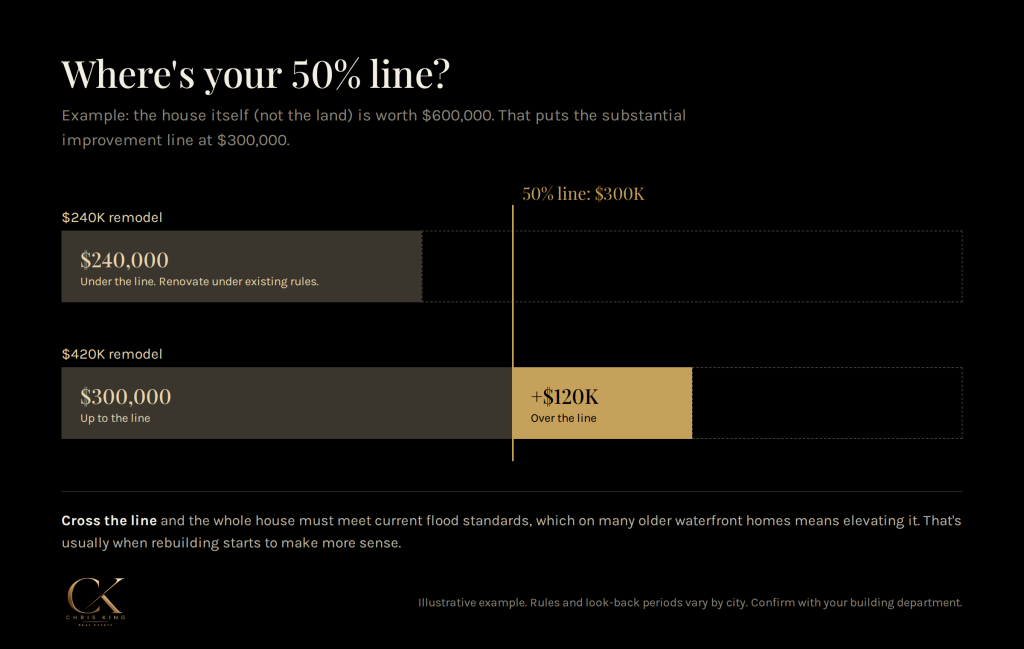
Under FEMA’s “substantial improvement” rule, if your renovation costs 50% or more of the structure’s market value, the whole home has to be brought up to current flood standards. And note, that’s the value of the house, not the land. On a lot of older waterfront homes, meeting those standards means elevating the house.
Now, that’s where renovation budgets go to die. A home built at grade decades ago can hit the 50% line fast. Once you’re elevating, you’re usually better off building new. On top of that, some cities count improvements over several years, so splitting a remodel into phases doesn’t always get you around it.
That’s why the first question I ask isn’t “What do you want to change?” Instead, it’s “What’s the structure worth, and where’s your 50% line?” And since the rules vary by city, we confirm with the local building department before anyone spends a dollar.
Option 1: Renovate
So when does renovating win? Simply put, when the bones are good and the house already sits high enough. If you can update the kitchens, baths, finishes, and systems while staying under the 50% line, you keep your footprint and skip a long build.
Renovating makes the most sense when:
- The home was built or elevated to a more recent flood standard
- The layout works and you’re updating, not reinventing
- You plan to live there for years and want to enjoy the result
- The seawall and dock are in good shape, or can be handled separately
That said, watch out for the trap: over-improving. At this level, buyers pay for location, elevation, and newer construction. As a result, a beautiful remodel on an old, low house often doesn’t get its money back at resale.
Option 2: Rebuild
On the other hand, on a lot of older waterfront homes, the land is the real asset and the house is worth close to zero. In that case, rebuilding lets you build at today’s elevation, to today’s hurricane code, at the size the lot actually allows. And that’s exactly what top buyers in this market are paying for. In my post on why North Miami waterfront is outpacing the rest of the market, I explain why that demand isn’t going anywhere.
Rebuilding makes the most sense when:
- A renovation would blow past the 50% line anyway
- The lot allows a significantly larger home than what’s there now
- You have the time (often two-plus years from design to move-in) and the appetite to manage a build
- New construction on your street is trading at a clear premium over older homes
Of course, the catch is time, cost, and risk. Design, permitting, and construction all take longer than owners expect, and meanwhile you’re carrying the property the whole way through. Also keep in mind that new construction gets added to your assessed value, so plan for a higher tax bill. I break that down in why your Miami property tax bill won’t look anything like the seller’s.
Option 3: Sell
Sometimes, though, the smartest move is to let someone else take on the project. But how you sell matters just as much as whether you sell. Here are your three paths:
- Sell as-is to a builder or a buyer who wants to build. This is the fastest and simplest route. The key, however, is pricing it as a lot, with the buildable square footage, elevation, and water frontage spelled out, not as a dated house.
- Sell with plans in hand. Having an architect draw a new home and pricing out the build lets buyers see the finished product and the real cost. In turn, that can widen the buyer pool and support a stronger price, without you ever swinging a hammer.
- Make targeted updates, then sell. This only works, however, when the house itself has value and a modest refresh changes how buyers see it.
The mistake I see most? Owners listing an obvious teardown as a “charming original home.” Buyers run the numbers on the lot no matter what, so the listing just sits.
Which Camp Is Your Home In?
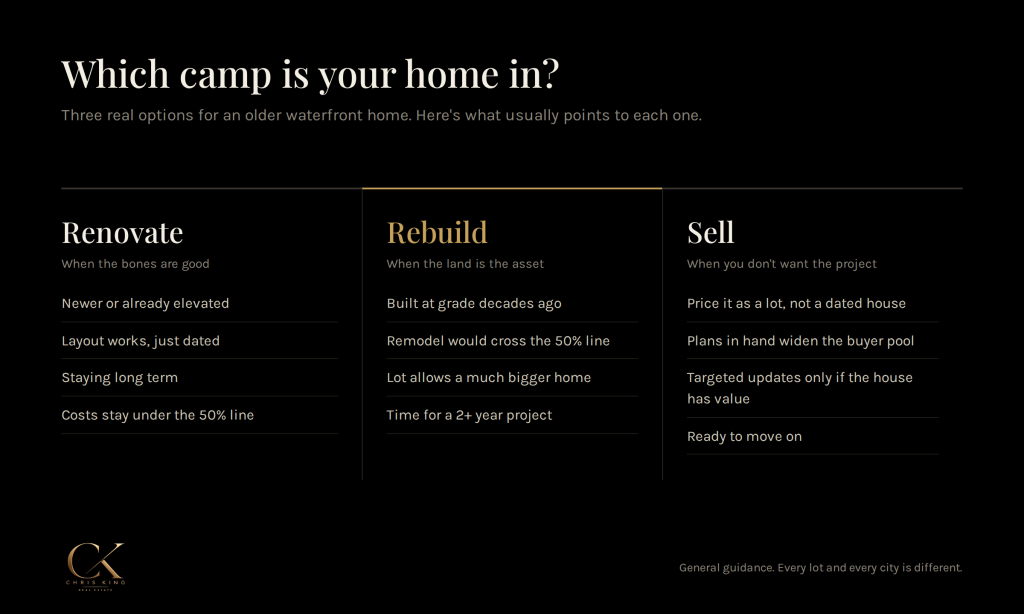
So where does that leave you? Usually, a few quick questions point you in the right direction:
- Newer or already elevated, solid layout, staying long term? You’re probably leaning toward renovating.
- Built at grade, dated systems, and the lot allows a much bigger home? Rebuilding is likely your play.
- Same situation, but you don’t want a two-year project? Then sell it as a lot, ideally with plans.
- Good house, just tired, and you’re ready to move on? Make targeted updates, then sell.
Still, the honest answer depends on numbers most owners don’t have: the structure’s value, your 50% line, real construction costs, and what finished new construction is trading for on your street.
Get the Real Numbers, Privately
And this is where I’m different from most agents. My family includes licensed general contractors and architects, so I can put real renovation and construction numbers next to the market data. Not guesses. Of course, if you ever decide to work with them, I’ll always disclose that relationship up front.
In a private strategy session, we’ll look at:
- What your home and lot would sell for today, as-is
- Rough renovation costs and where your 50% line likely falls
- What the lot supports as new construction, and what that home would be worth
- What each path would actually net you
There’s no obligation and no pressure to list. In fact, sometimes the right answer is to stay put and renovate, and if that’s the case, I’ll tell you.
Bottom Line
At the end of the day, on the water, you’re not just deciding what to do with a house. You’re deciding what to do with one of the most valuable pieces of land you’ll ever own. So don’t make that call on a guess.
Call me at 954-857-1017, and let’s run your real numbers.
This is general information, not legal, engineering, or construction advice. Flood rules and look-back periods vary by city, so confirm requirements with your local building department before making decisions.