
No Fixed Bridges? What That Line in a Miami Waterfront Listing Really Means for Your Boat
October 15, 2026By Chris King, North Miami Real Estate Advisor, Compass FL
If you’ve shopped for a waterfront home in Miami, you’ve seen it in the listing: “No fixed bridges.” For a boater, it’s one of the most valuable phrases in real estate. It can add real money to a price, and it can make or break a sale.
But here’s the thing. It doesn’t always mean what buyers think it means. So before you buy a home for the boat, or sell one to a boater, let me explain what’s really going on out on the water.
Why Bridges Matter So Much
First, the basics. A fixed bridge doesn’t open. So if your boat is taller than the bridge, you’re not getting under it. Period.
That height is called your boat’s air draft, and it’s the number every waterfront buyer should know before they fall in love with a dock. A center console might stand 10 feet tall. A sportfish with a tower can be twice that or more. A sailboat’s mast can be taller still.
A drawbridge is different. It opens, but often on a schedule, so it can cost you time but won’t keep you in.
The Two Ways Out of North Biscayne Bay
If you live on the water in North Miami or Bal Harbour, you have two ways to reach the ocean.
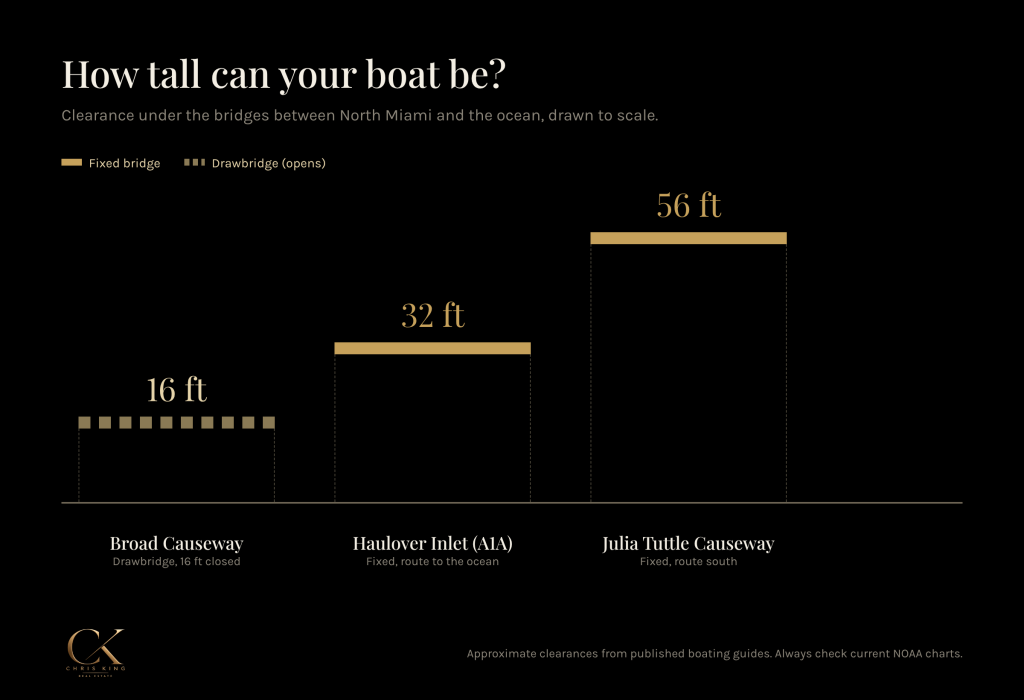
Haulover Inlet is the one most local boaters use. It was cut in 1925 between Bal Harbour and Sunny Isles, and from Sans Souci or Keystone it’s a short run up the bay. But A1A crosses the inlet on a fixed bridge, and boating guides put its clearance at about 32 feet.
Government Cut is the big-ship channel to the south, by Miami Beach Marina and Fisher Island. But to get there from North Miami, you run down the bay and under the Julia Tuttle Causeway, a fixed bridge with about 56 feet of clearance.
So What Does “No Fixed Bridges” Actually Mean?
In practice, when you see “No Fixed Bridges” on a North Miami listing, it generally means there’s no low fixed bridge between your dock and the open bay. Your canal isn’t boxed in, and you don’t have to duck under a 10-foot road bridge to get anywhere.
What it doesn’t mean is that there’s nothing between you and the ocean. Every boat heading out Haulover passes under that 32-foot span.
Now, for most boaters, that’s no problem at all. Center consoles, bowriders, express cruisers and plenty of sportfish clear it easily. But if you own a sailboat or a tall yacht, those 32 feet decide everything. And if your boat stands taller than 56 feet, the southern route is closed too.
Don’t Forget the Drawbridge
There’s one more bridge to know about: the Broad Causeway, which connects North Miami to Bay Harbor Islands. It’s a drawbridge with about 16 feet of clearance when it’s closed. It opens on signal, except from 8 a.m. to 6 p.m., when it only opens at a quarter past and a quarter to each hour.
What this means for you: depending on where your dock sits relative to the causeway, and how tall your boat is, you may be timing your trips around a drawbridge. Not a dealbreaker, but worth knowing before you buy.
Haulover Has a Personality
Here’s something the listing won’t tell you. Haulover Inlet can be rough. Currents run around 4 to 6 knots, and when the wind blows against the tide, the inlet can stack up waves big enough to swamp an unprepared boat.
Experienced local captains time their runs around the tide and the wind. So if you’re new to boating in Miami, learn the inlet before you need it.
Neighborhood by Neighborhood
- Keystone Islands: Built in the 1950s and ’60s with boaters in mind, Keystone’s canal-front lots and private docks put you minutes from Haulover. One home on Keystone Boulevard with 83 feet of dock on the Intracoastal sold for $5.3 million this summer.
- Sans Souci: Bayfront and canal-front homes with quick access to the bay. Check where your dock sits relative to the Broad Causeway.
- Bal Harbour: The bayfront estates on Bal Bay Drive sit just inside Haulover, about as close to the inlet as you can live.
Your Waterfront Buyer’s Checklist
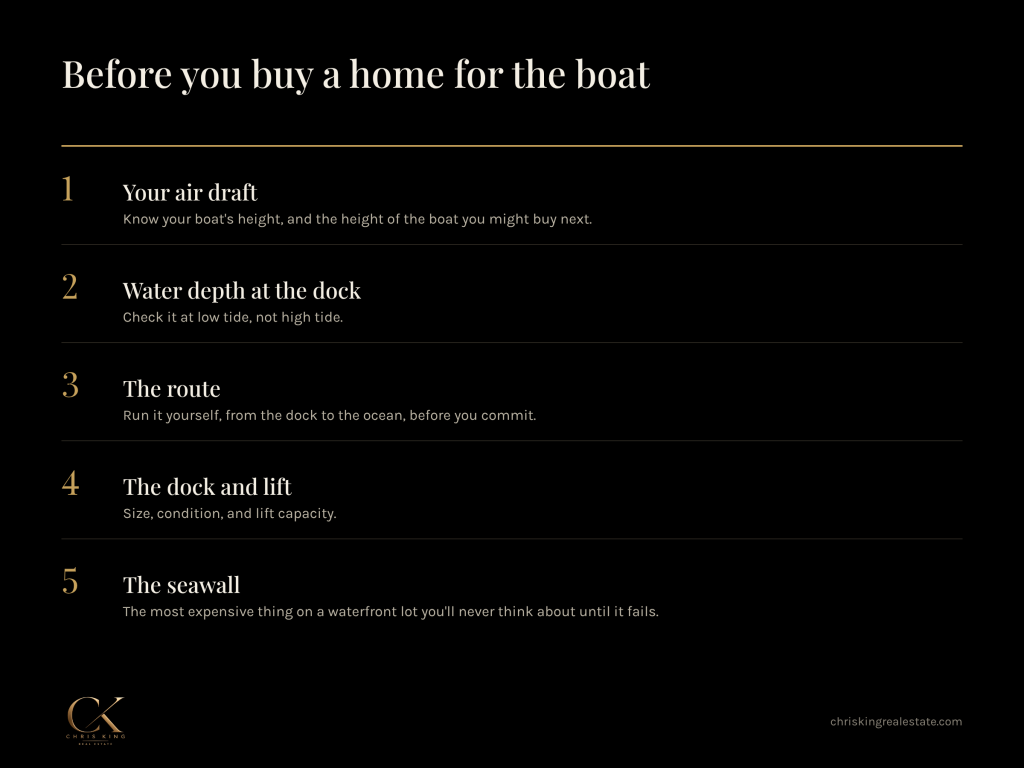
Before you buy a home for the boat, check these five things:
- Your air draft. Know your boat’s height, and the height of the boat you might buy next.
- Water depth at the dock. Check it at low tide, not high tide.
- The route. Run it yourself, from the dock to the ocean, before you commit.
- The dock and lift. Size, condition, and lift capacity.
- The seawall. It’s the most expensive thing on a waterfront lot you’ll never think about until it fails. I break it down in Seawalls and Dock Permits in Miami.
If You’re Selling a Waterfront Home
Boating buyers do their homework, so be accurate. Instead of leaning on “no fixed bridges,” tell them exactly what they get: minutes to Haulover, the dock length, the lift capacity, and the depth. Specifics sell. And they build trust with the exact buyers who’ll pay a premium for your water.
Bottom Line
On the water in Miami, the bridges between your dock and the ocean matter as much as the house. So know the numbers before you buy, and sell with them.
If you’re looking for a home that fits your boat, from Keystone to Bal Harbour, call me at 954-857-1017. Let’s find the right water.
Navigation details are general information. Always check current NOAA charts and Local Notices to Mariners before transiting.
Sources